Brand Logo Moneyfacts Group plc
Telephone Icon T: 01603 476476 Email Icon E: enquiries@moneyfacts.co.uk LinkedIn Icon

Bank profit surcharges to temporarily rise to 6%

Image of Moneyfacts.co.uk Brand Logo Image of Moneyfacts.co.uk Brand Logo Image of Moneyfacts.co.uk Brand Logo
Adam French, Head of Consumer Finance 01603 476154 Email Adam
28/10/2026

Bank profit surcharges to temporarily rise to 6% 


Adam French, Head of Consumer Finance at Moneyfacts, said:

“Temporarily hiking the bank profit surcharge from 3% to 6% comes at a time when major banking groups are reporting substantial profits during a period of higher-for-longer rates.

“Higher interest rates can support bank earnings by widening the spread between lending and saving rates, although it varies by bank and over time. If interest rates remain higher, banks should have more headroom to absorb the surcharge increase than when rates were near historic lows. However, higher rates do not automatically produce higher profits, and the effect depends on each lender’s funding costs, deposit mix, lending book, credit losses and approach to managing margins.

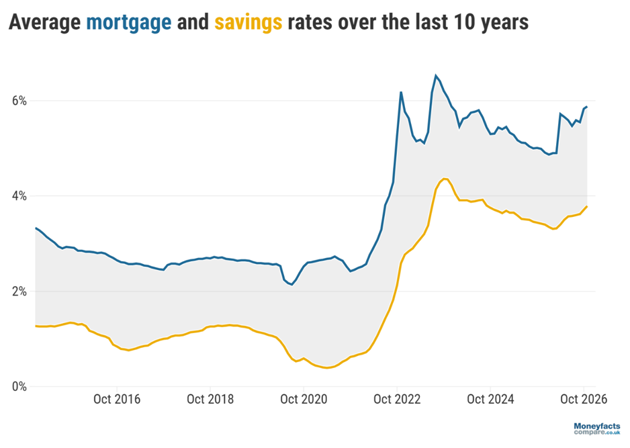
“While by themselves not a measure of banks’ profit margins, the latest Moneyfacts figures show an average advertised new mortgage rate of 5.88%, compared with an average new savings rate of 3.79%, a gap of 2.09 percentage points. Mortgage pricing also reflects funding and hedging costs, operating expenses, capital requirements, credit risk and competition. While it will differ across institutions, it suggests that lenders should have the capacity to absorb higher costs over the fifteen months from January 2027.

“Banks have also benefited from rising interest payments on money created through the Bank of England’s quantitative easing programme. These payments are made at the Base Rate and have increased sharply as rates have risen, with the overall cost ultimately falling on the public finances.

“Competition and commercial forces will shape how banks respond, as things stand the cost felt by customers is likely to be modest, if any - particularly in a competitive market.”


Notes

Moneyfacts Average New Mortgage Rate is calculated from the total of all on-sale, core market, fixed and variable tracker mortgages. Standard exclusions apply: Self-build only, shared ownership only, new build only, shared equity only, standard variable rates and adverse credit.

Moneyfacts Average New Savings Rate is calculated from the total of all on-sale, core market, variable and fixed rate savings accounts and Cash ISAs.  Standard exclusions apply: Regular savings, children’s accounts, LISAs and JISAs.


Notes to editors

You are welcome to use part or all of this press release, so long as we are sufficiently sourced. We would appreciate a link back to Moneyfactscompare.co.uk.

Pioneering financial comparison technology for over 38 years, Moneyfacts Group plc is the UK’s leading provider of retail financial product data. Used by virtually every bank and building society in the UK, and supplied to the Bank of England, Financial Conduct Authority, Financial Ombudsman Service, HM Treasury, Prudential Regulatory Authority and UK Finance.

Our expert research team monitors the thousands of mortgages, savings, credit card, personal loan, banking, life, pension and investment products in the UK.

Moneyfactscompare.co.uk is the financial product price comparison site, launched as Moneyfacts.co.uk in 2000 and rebranded to Moneyfactscompare.co.uk in 2023, which helps consumers compare thousands of financial products, including credit cards, savings, mortgages and many more. Unlike other comparison sites, Moneyfactscompare.co.uk shows whole of market data regardless of commercial bias, showing consumers a true picture of the best products based on the criteria they select.

For more information about us please see our key facts.

Broadcast

Our broadcast suite enables our finance experts to appear in-vision for television, and we regularly comment live on national and regional radio.

To arrange an interview for radio or television, please contact our press department. We have an in-house broadcast room.


 

Notes to editors

You are welcome to use part or all of this press release, so long as we are sufficiently sourced. We would appreciate a link back to Moneyfactscompare.co.uk.

Pioneering financial comparison technology for over 38 years, Moneyfacts Group plc is the UK’s leading provider of retail financial product data. Used by virtually every bank and building society in the UK, and supplied to the Bank of England, Financial Conduct Authority, Financial Ombudsman Service, HM Treasury, Prudential Regulatory Authority and UK Finance.

Our expert research team monitors the thousands of mortgages, savings, credit card, personal loan, banking, life, pension and investment products in the UK.

Moneyfactscompare.co.uk is the financial product price comparison site, launched as Moneyfacts.co.uk in 2000 and rebranded to Moneyfactscompare.co.uk in 2023, which helps consumers compare thousands of financial products, including credit cards, savings, mortgages and many more. Unlike other comparison sites, Moneyfactscompare.co.uk shows whole of market data regardless of commercial bias, showing consumers a true picture of the best products based on the criteria they select.

For more information about us please see our key facts.

Broadcast

Our broadcast suite enables our finance experts to appear in-vision for television, and we regularly comment live on national and regional radio.

To arrange an interview for radio or television, please contact our press department. We have an in-house broadcast room.

 

Contact Us If you're looking for extra comment, a chart or more information, then please give us a call. We are always more than happy to help.
Adam French Head of Consumer Finance
Rachel Springall Finance Expert
Caitlyn Eastell Personal Finance Analyst